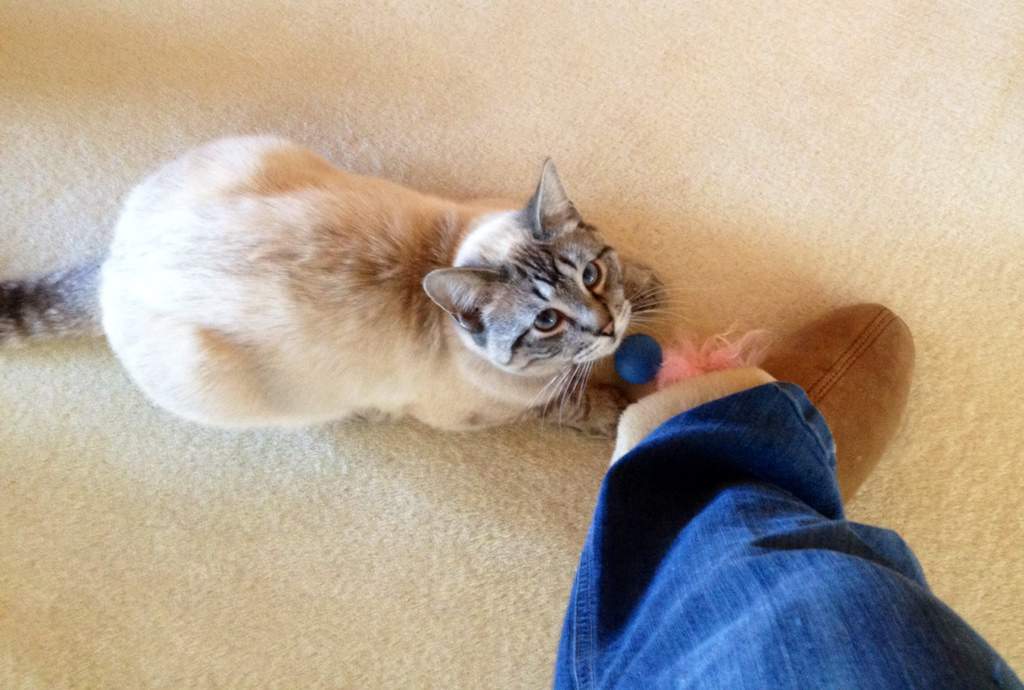
Do your cats chase your feet? Fun and games for them mean DANGER for humans! Youngsters think EVERYTHING invites play-attack, but cats chase feet at any age. Karma-Kat has decided bare ankles merit a bite-attack each evening, while I try to relax and watch television. He does this at night in the dark, too, if I have to get up for any reason, yikes! It’s part of kitty play.
Seren-Kitty also enjoyed targeting toes, but since she only weighed 6 pounds, at most we endured a furry ankle decoration. With big cats like Karma (13+ pounds!), when cats chase feet, it can be a dangerous tripping hazard.
Why Cats Chase Feet?
Karma-Kitten does this. He even does it to Magical-Dawg. When Seren was young, she also targeted my feet and ankles. Do they really want to maim us, or worse: trip us on the stairway so we’ll break our necks? Do cats have mayhem in mind?
Even when they outgrow the “attack phase” at around 9 months of age that characterizes kitten play aggression (yes, folks, it’s NORMAL!), cats still have an affinity for feet. Recently I had a question from someone asking if our cats tried to “herd” us by winding between our feet as we walked? That gave me visions of packs of Border Collie Kitties. Hmnn, now there’s a project for some ingenious YouTube green screen folks to create!
Do your cats chase feet? What in the kitty-world is going on? No, it’s not malicious or psychotic or vicious or any of those other labels we humans love to attach. Again, it’s normal, and has to do with several things either separately or in combination. Part of the behavior arises from hard-wired cat hunting instinctual behavior.
CATS CHASE FEET BECAUSE OF HUNTING INSTINCT
As hunters, cats’ hunting behavior evolved to be prompted by different stimuli. That’s a survival mechanism that triggers pounce-and-attack to put food on the feline table. Several things trigger the urge to hunt–and the cats chase feet instinct.
Sound, such as the ultrasonic mouse squeaks can stimulate attack. Scent is also important especially to stimulate appetite, but cats don’t have to be hungry to hunt. They have to take advantage of every opportunity and not give that mousy morsel a pass, just because their tummy is full. So other senses are more important to trigger predatory behaviors. And let’s face it, chasing feet qualifies as prey to kitten-hunters.
Sight rules in terms of kitty attack triggers. Think about it: the motion of our feet walking is at kitty eye level (prey location!), and the continued movement self-rewards the cat’s interaction. Couch Potato Puss has no real prey, so makes do with surrogates. It’s just FUN for the cat to chase/tag/play with our feet and ankles. And the more you squeal and try to shake ’em off (like prey), the more the cat’s hunting engine revs.
But the behavior can go on for other reasons.
“YOU BELONG TO ME!”
Again, cats are all about territory and location is important. The eye-level location of our ankles/feet as well as what they represent–the human they adore–makes ankles/feet prime kitty marking targets. It’s hard for the cat to reach other body parts with any regularity, but our tootsies are always within paw-and-cheek reach.
Cats mark important owned territory with cheek rubs, body rubs, tail winding, etc. When they wind around our feet and ankles, this leaves scent marks that you are important and owned by them–a huge feline compliment. A common time at our house for both Seren-Kitty and Karma-Kitten to indulge in this body-rub-fest is right after the humans get out of the shower. That makes scent sense because a shower or bath washes off all the important “family smell” that identifies you as safe and known. The cats need to refresh these marks to feel all warm-and-fuzzy-friendly.
String on shoes tempts many cats to chase.
IT’S YOUR FAULT CATS CHASE FEET!
Hey, the cats made me say that! They’re always MEOWING about something. But there’s truth to the statement. If you hate having the cat(s) constantly underfoot, take a step back (carefully, LOL!) to see what YOU do when this happens. It could be that you’re actually rewarding the behavior and reinforcing it, so the cats continue to target your feet. Also, bored cats need enrichment to maintain emotional health, so things like scent enrichment can help stem the mayhem of when cats chase feet.
Cats are very easily trained. It only takes one or two repetitions for them to connect-the-dots and say, “Hey, if I do THIS, then my human does THAT!” And if your cat happens to like THAT (a scream, you jumping around, picking them up, filling the food bowl, opening the door, giving ATTENTION) that can reward the cats chase feet behavior. Remember that even bad attention is sometimes better than being ignored. (I suspect parents of two-legged kids will agree with that, too.) As I said, cats are very easily trained, but they’re even better trainers of us humans. Ahem.
Cats love to rub to leave scent markings, but can trip the unwarry.
Your Turn: How do YOU Stop Cats Chasing Feet?
So how do you manage your ankle-rubbing/biting-kitties? Right now, we’re just watching our step–literally–and stopping in place until Karma moves on. No motion makes feet less attractive and doesn’t reward paw-grapples. Because once the behavior is ingrained, it’s even more difficult to stop. Prevent the cats chase feet behavior before it starts.
There’s lots more fun info and tips for your rambunctious kitties in COMPLETE KITTEN CARE (and you can “hear” me in the Audio version, too!)
I love hearing from you, so please share comments and questions. Do you have an ASK AMY question you’d like answered? Do you have a new kitten and need answers? Stay up to date on all the latest just subscribe the blog, “like” me on Facebook, and sign up for Pet Peeves newsletter.
Stay up to date with the latest book giveaways and appearances related to my September Day pet-centric THRILLERS WITH BITE! Amy Shojai, CABC is a certified cat & dog behavior consultant, a consultant to the pet industry, and the award-winning author of 35+ pet-centric books and Thrillers with Bite! Oh, and she loves bling!
Related
17 Comments
Vicki L Taylor
on March 5, 2018 at 8:48 am
I recently adopted 6 month old “Pi” from the shelter and love her dearly. She id a very affectionate and outgoing Calico, but when it is time to eat she seems to think she is going to starve to death if she does not force me to the food bag by winding in and out of my feet. She has never attacked or bitten them at all fortunately, but I have nearly fallen a few times when she is winding around them. I will usually just hook a foot under her and slide her out from me on the tile or hardwood floor….not a lick and not any force, but seems to give her the idea that she needs to stay out from under if she wants to be fed. That is beginning to work, along with stopping in my tracks when it first starts. If my progress toward the food stops, she seems to realize that her behavior is not accomplishing her goal.
Hi Vicki, That’s an excellent way to handle the issue. By stopping your movement when she gets underfoot, she realizes SHE controls your movement–and must get out of the way if you’re to read the food. Smart kitty! And smart human! Thanks for stopping by the blog.
We are elderly and adore our cat Mitty. But she winds herself around our feet and I am afraid she might cause us to fall. How can we break her of this habit?
Hi Bonnie. Many cats do this, not just Mitty (love the name, by the way!). One thing you can do is find something Mitty really likes–a treat, a long distance toy?–and have that always available in your pocket. When Mitty approaches, BEFORE she makes contact with your feet, toss the toy/treat out ahead of you. Once she makes contact, DO NOT give her the toy or treat…you want her to eventually learn that she’ll earn a reward by ignoring your feet. It can take quite a bit of time, so be patient. But then, you (and Mitty) are worth it, right? *s*
Oh yes I can relate to this. Cheek and body rubs. I see 2 year old Termite cheek rubbing the bathroom door facings every day and of course he is still the designated potty partner escort. Termite usually sleeps between my feet and comes 20-30 minutes after I go to bed. He has woke me up during the night after my feet, especially my big toe. I try and stay as stiff as a board so I won’t be attacked. Being diabetic I must be very careful. Adding additional info from above to your ComPETability: Cats book would be great!
I used to joke that tripping humans was bored indoor cats trying to add excitement to their lives, not realizing that those with only one human might lose their home if their human was injured too badly. Ours have all gotten tired of me explaining it all to them….
Awww…yes, that can happen. Also, some humans have very fragile skin and just a small scratch or nibble can be very painful and lead to dangerous infection. *sigh* Wish we could explain more clearly to our cats!
Haven’t been online much lately but I had to write about my experience here. Mewdy BLue used to wrap himself around my ankles whenever I got one of the stick toys out to play with all the cats at once. All the others raced around chasing the toy but Mewdy Blue claimed my ankles and hung on while swatting at the toy. Guess he was claiming his personal space 🙂
We’re still working on an anomaly from about a month ago that has never happened before or since. Anubis does occasionally go into play mode and jump for feet, but usually it’s a chomp-and-run. We had one where we were just sitting on the couch, cat runs by and jumps at J’s feet, then bites in and just starts SHAKING it. It was a bit of a fight to get him off. He has never done that when playing. We can’t think of anything nearby that might have made him think something was after us to have him mistakenly chomp a foot in defense or something (and to me it looked more like a move to defend something than an attack on prey, just the particular way the body movements were going – really kind of hard for me to explain what I mean here). The only thing we can figure was, since we found out later he was having some tummy troubles (lots of hairballs this winter, it’s been awful on him) was maybe it hurt just at the moment he was walking by, since the attack came on so suddenly.
Ouch! unexpected/uncharacteristic attacks certainly would raise my antennae for a health issue. I’m glad it hasn’t happened since. And of course, there may have been some undetected sound that Anubis could hear and you couldn’t that triggered the behavior.
Every year, I write about our old cat needs. While Karma-Kat has just reached middle age, cats age at different rates. When do you consider your cat old? Is your old cat a senior kitty by age 8, or 13, or…when? For cats, what is old? Here’s how the experts define ‘old age’ in cats…
Can we take a minute to talk about something almost every pet parent deals with?
Although pet hair and odors are a small price to pay to have our furry ones at home with us, the fuzz and funky smells can sometimes seem overwhelming!
This morning as I stared into the face of my grinning Shadow-Pup and dodged his bruising tail flagellations, I envied him. And I envied my Karma-Kat and Trinity-Kittty who still hadn’t roused themselves from daily 16-plus-hour sleep marathons. I mean, I really had a moment of green-eyed angst that Shadow lives a dog’s life and the cats lives in a dream-world (literally!) while my husband and I bust our buttons keeping them in kibble. But is this a fair assessment? Just for fun, here’s a comparison.
Yes, cat separation anxiety affects many felines. When school restarts, and the kids go back to class, your cats (and your dogs) may suffer from separation anxiety. The signs of distress are very different, though. I encourage you to read on to learn about tips for helping your furry family members adjust.
We very often hear about doggy angst during a beloved human’s absence, but what about cats? Yep, it’s exactly the same—only different. Here’s how.
WIth back to school this month, you may wonder how to deal with dog separation anxiety. Whether the adults change work schedules, kids have less time to play with Fido, or college and classes means routine goes out the window, dog separation behaviors cause stress for everyone. Will canine separation anxiety become a problem for your dog? After summer vacation with the kiddos, dogs left behind at home can mope and feel awful…and so can cats. Any kind of absence might result in canine separation anxiety. Here’s what you need to know.
It’s National Pet Health Month! Each November, we celebrate old dogs during their “official” month. But when is your dog considered old? We love our senior citizen dogs for the special joy they bring every day. But once a year, we celebrate old dogs during November Adopt A Senior Pet Month.
What is considered “old?” There are individual differences between pets, just as there are for people. While one person may act, look and feel “old” at fifty-five, another fifty-five-year-old remains active with a youthful attitude and appearance. Aging is influenced by a combination of genetics, environment, and health care over a lifetime. The oldest dog on record was an Australian Cattle Dog who lived for twenty-nine years and five months…
I’ve written about how to care for an elderly dog before, but this post addresses how to know when your canine friends become old dogs.
Have you ever considered holistic medicine for your pets? There are many questions about what is holistic pet care. Is it the same thing as what your regular vet offers? There are many names for offering traditional medicine for pets. Some call it alternative medicine or natural healing. But are there specific definitions, and is holistic pet care a good choice for your cats and dogs? August 30 is National Holistic Pet Day, so it’s a good time to revisit asking these questions.
Visit Amy's Website
Amy Shojai CACB is an award winning author. You can find all her publications and book her to speak via her website.
AmyShojai.com is a participant in the Amazon Services LLC Associates Program, an affiliate advertising program designed to provide a means for sites to earn advertising fees by advertising and linking to amazon.com http://amazon.com/.

















I recently adopted 6 month old “Pi” from the shelter and love her dearly. She id a very affectionate and outgoing Calico, but when it is time to eat she seems to think she is going to starve to death if she does not force me to the food bag by winding in and out of my feet. She has never attacked or bitten them at all fortunately, but I have nearly fallen a few times when she is winding around them. I will usually just hook a foot under her and slide her out from me on the tile or hardwood floor….not a lick and not any force, but seems to give her the idea that she needs to stay out from under if she wants to be fed. That is beginning to work, along with stopping in my tracks when it first starts. If my progress toward the food stops, she seems to realize that her behavior is not accomplishing her goal.
Hi Vicki, That’s an excellent way to handle the issue. By stopping your movement when she gets underfoot, she realizes SHE controls your movement–and must get out of the way if you’re to read the food. Smart kitty! And smart human! Thanks for stopping by the blog.
We are elderly and adore our cat Mitty. But she winds herself around our feet and I am afraid she might cause us to fall. How can we break her of this habit?
Hi Bonnie. Many cats do this, not just Mitty (love the name, by the way!). One thing you can do is find something Mitty really likes–a treat, a long distance toy?–and have that always available in your pocket. When Mitty approaches, BEFORE she makes contact with your feet, toss the toy/treat out ahead of you. Once she makes contact, DO NOT give her the toy or treat…you want her to eventually learn that she’ll earn a reward by ignoring your feet. It can take quite a bit of time, so be patient. But then, you (and Mitty) are worth it, right? *s*
Oh yes I can relate to this. Cheek and body rubs. I see 2 year old Termite cheek rubbing the bathroom door facings every day and of course he is still the designated potty partner escort. Termite usually sleeps between my feet and comes 20-30 minutes after I go to bed. He has woke me up during the night after my feet, especially my big toe. I try and stay as stiff as a board so I won’t be attacked. Being diabetic I must be very careful. Adding additional info from above to your ComPETability: Cats book would be great!
Thanks Patricia. That’s the beauty of the Ebook, I can update pretty easily. *s*
I used to joke that tripping humans was bored indoor cats trying to add excitement to their lives, not realizing that those with only one human might lose their home if their human was injured too badly. Ours have all gotten tired of me explaining it all to them….
Awww…yes, that can happen. Also, some humans have very fragile skin and just a small scratch or nibble can be very painful and lead to dangerous infection. *sigh* Wish we could explain more clearly to our cats!
Iz tru we kittehs like to pounce on anyfing dat moves n dat includes humanz feets (especially fun when dem feets r under covers)!
Boris Kitty, that’s absolutely true at our house especially from the “new kid” Karma. He’s only about 7 months old and finds footsie-tag a great game!
Haven’t been online much lately but I had to write about my experience here. Mewdy BLue used to wrap himself around my ankles whenever I got one of the stick toys out to play with all the cats at once. All the others raced around chasing the toy but Mewdy Blue claimed my ankles and hung on while swatting at the toy. Guess he was claiming his personal space 🙂
LOL! It reminds me of that funny commercial where the guy says, “They’re not fuzzy boots. They’re my cats.”
We’re still working on an anomaly from about a month ago that has never happened before or since. Anubis does occasionally go into play mode and jump for feet, but usually it’s a chomp-and-run. We had one where we were just sitting on the couch, cat runs by and jumps at J’s feet, then bites in and just starts SHAKING it. It was a bit of a fight to get him off. He has never done that when playing. We can’t think of anything nearby that might have made him think something was after us to have him mistakenly chomp a foot in defense or something (and to me it looked more like a move to defend something than an attack on prey, just the particular way the body movements were going – really kind of hard for me to explain what I mean here). The only thing we can figure was, since we found out later he was having some tummy troubles (lots of hairballs this winter, it’s been awful on him) was maybe it hurt just at the moment he was walking by, since the attack came on so suddenly.
Either way it hasn’t happened since then.
(and once again I forget to check the little box. Argh I need to find a way to make it check that thing by default LOL)
Ouch! unexpected/uncharacteristic attacks certainly would raise my antennae for a health issue. I’m glad it hasn’t happened since. And of course, there may have been some undetected sound that Anubis could hear and you couldn’t that triggered the behavior.
Yeah, doesn’t help he’s been jumpy with the coyotes yowling outside all the time at night lately to begin with. x.x
Aha…now that could explain it. We’ve had lots of coyote singing lately, too.