
One of the top questions I receive involves how to stop cats from clawing. The answer is–you can’t! But you CAN teach them to scratch “legal” options instead of your furniture. And of course, you can clip your cat’s claws–here’s how. As with other behavior “pet peeves,” the key is understanding the issue from the cat’s point of view.
How to stop a dog from barking got the most canine topic votes one of my informal Facebook polls so it’s time for the cats’ turn. Cat clawing is one of the common complaints so as a warm-up, here are some quick tips and in the future webinar, I’ll expand the answers and give y’all some prescriptive how-to help. See, I want my next big project (an on-demand pet behavior course) to answer YOUR must-know questions.
So here’s your turn. Fill in the blank in the comments: “I wish I knew how to fix my cat/dog’s (…..)”
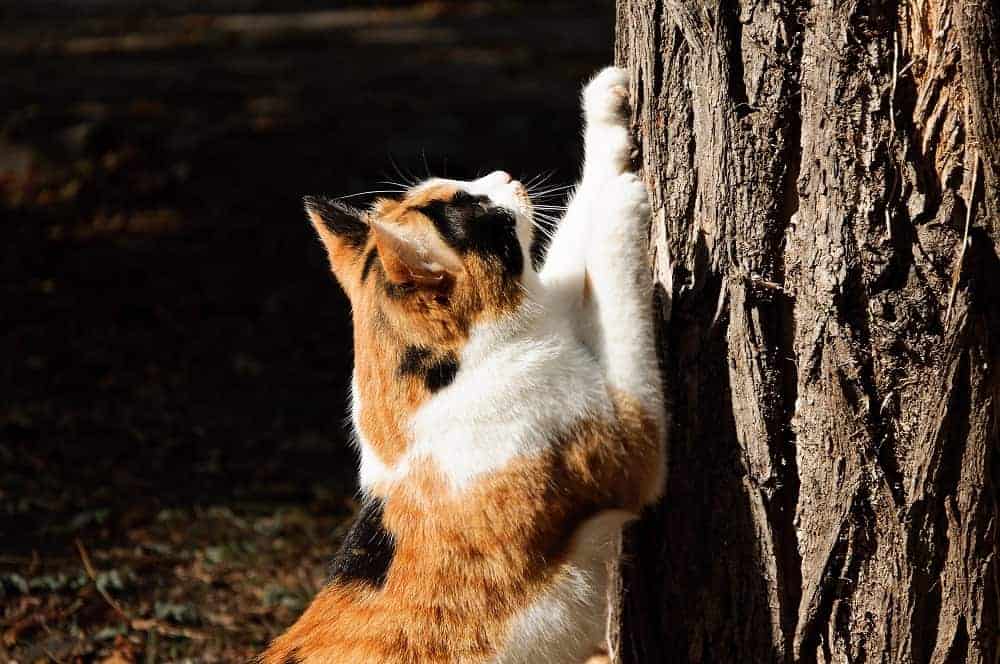
Why Do Cats Scratch?
Kittens and adult cats claw for many reasons. Clawing feels good and provides a great shoulder and leg workout. Clawing keeps nails healthy by cleaning off old layers. Clawing marks kitty territory with paw pad scent and visual cues of your shredded upholstery.
Clawing may raise your blood pressure, but it relieves feline stress, sort of like the kitty equivalent to human nail-biting. In fact, upset cats often claw-target items that smell the most like a beloved human (your bed, your favorite chair), not because they’re angry or vindictive—but because they love you so much and scent-sharing makes them feel better. Karma uses me as a movable scratch object, and that’s fine as long as I’m wearing jeans…but bare legs, oh-my-cod!
Cat clawing is normal. You can’t stop this natural behavior, not even with declawing surgery. Declawed cats still go through the motions, and also can develop other behavior or health issues. But you can redirect kitty claws to “legal” targets so she stays happy and healthy.

10 Tips for Cat Scratch Training
- Cat Scratching Post: Cats could care less about posts that complement your décor. Irresistible choices match the cat’s desires for texture and style. Does your cat scratch horizontally or vertically—or maybe overhead while scooting on her back? Does he target upholstery, carpet, soft fabric or hardwood? Choose accordingly. Scratch objects should be taller or longer than the cat’s full-length stretch as an adult (because kittens do grow!), and sturdy enough it won’t tip over under a full-out scratch assault. Counter top cruising cats appreciate a tall post to climb. See tips here for dealing with counter loungers.
- Location: Scratching is territorial marking ruled by location. Cats want the whole world to see their scratch-graffiti so don’t hide the post away in a back room. Take cue from the location of the shredded sofa, or carpet on the stairs. Important pathways, lookouts (near windows), feeding stations and potty locations all fit the feline real estate criteria.
- 1+1 Rule: Provide a scratch object for every cat in the house—plus one. That means two cats should have at least three legal places to scratch, for example. Some cats won’t want to share and having posts in multiple locations means even a singleton cat has no excuse to use the bedroom mattress instead.
- Timing: Cats love routine, and often scratch at the same times and places each day: after naps, after meals, as a greeting display (when you come home), after play. Schedule claw-training during these times.
- Entice: Use a feather toy or other irresistible lure to draw the kitten’s attention to the right target. Tempt the kitten to climb and claw, and praise with soft happy encouragement. Older kittens and adults that react to catnip may be attracted to a catnip-spiked claw object. A tattered scratched up post looks good to the cat, so don’t replace it. And catch kitty in the act of doing it right, and praise praise praise!
- Use Nature: Pheromones are chemicals cats use to communicate through scent. A relatively new product called FeliScratch is an analog of the paw pheromones that cats use to scent-mark objects when they scratch. This product comes as pipettes (tiny test tubes of blue liquid) that you use to spike the LEGAL scratch object. The scent draws kitty to the scratching post (there’s a bit of catnip in there to boost the effect), and the blue tinge offers a visual cue. FeliScratch manufacturer claims 80 percent or more of cats respond favorably.
- Explain & De-stress: You can use another pheromone product called Feliway. It’s an analog of the cheek pheromone cats use to mark territory identified as owned and safe. You can spray Feliway on forbidden objects your cat scratches—like the arm of the sofa—to signal that she’s already marked the place and refreshers aren’t needed. Feliway also can reduce territorial stress that can prompt many cats to increase scratching behavior. Hey, when you’re stressed, maybe you bite your nails or eat chocolate—cats increase scratching.
- Train: Make the legal scratch object irresistible while making furniture unattractive—at least until the kitty accepts the proper post. Place the legal scratch object right in front of the scratched sofa, until the cat changes scratch-allegiance to the legal target. Double-sided sticky tap feels nasty to paws, for example. Depending on your furniture’s color, baby powder or cinnamon can be dusted on the furniture for a scented and poof-in-the-face reminder if claws hit. Interrupt wrong behaviors with a hand-clap or short hissing sound and then redirect to the right object and praise.

9. Trim Claws: Needle sharp kitten claws are easy to trip with human nail clippers. There’s no rule you must trim all at one time—do one claw each night when Junior sleeps on your lap. Gently press the pad to express the claw, and clip just the sharp end, and avoid the pink. Dull claws do less damage even if Junior forgets. Kittens that accept claw trims grow into adults that accept paw handling, too. Vinyl nail covers (in fashion colors) also are an option. These glue onto the cat’s claws to prevent clawing damage but grow out and must be replaced regularly.
10. Cat-Proof Screens. Do your cats target the window or door screens? To answer that question, I posted the Ask Amy (below) on dealing with screen-scratching kitties. I wanted to share one tip in particular that came from Gretie’s Mom who said they bought a roll of the Pet Resistant Screen from Orchard Supply Hardware that is not invincible, but it works pretty well.
Every kitten is an individual. Some rarely scratch at all, while others become scratch-aholics, especially during emotional upset. Stay tuned for announcements about the webinars and more “Kitty Aptitude Training (KAT)” help to positively manage your kitten’s claws-and-effect (and other pets peeves).

I love hearing from you, so please share comments and questions. Do you have an ASK AMY question you’d like answered? Do you have a new kitten and need answers? Stay up to date on all the latest just subscribe the blog, “like” me on Facebook, and sign up for Pet Peeves newsletter.
Stay up to date with the latest book giveaways and appearances related to my September Day pet-centric THRILLERS WITH BITE! Amy Shojai, CABC is a certified cat & dog behavior consultant, a consultant to the pet industry, and the award-winning author of 35+ pet-centric books and Thrillers with Bite! Oh, and she loves bling!















Really, really helpful! Thank you.